

The Coats Of Arms for the London Borough of Islington
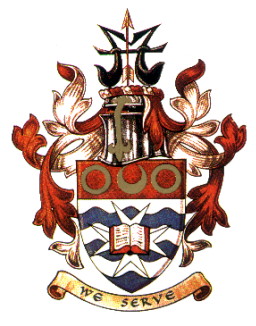
The Coats Of Arms for the London Borough of Islington are made up of the following features:
- The water-bouget above the helm was taken from the Arms of the Berners family who became possessed of lands in Islington after the Norman Conquest - known as Bernersbury afterwards, and later Barnsbury.
- The arrow symbolises the past association of the borough with archery.
- The yellow crescent with the red background on the shield is taken from the arms of Thomas Sutton, the founder of the Charterhouse and the annulets (yellow rings) occur in the arms of both Thomas Sutton and Sir Richard Whittington.
- The background of the shield comprises a wavy field in blue and white symbolising the associations of the borough with water.
- The book of learning superimposed on this wavy field symbolises the educational institutions in the borough which now include the London Metropolitan University, Capital City College and City University.
- The Maltese Cross refers to the Order of St John of Jerusalem.
From this Coat of Arms the council has also approved the design of its badge which can be fixed to uniforms, vehicles etc, incorporating a heraldic charge called a fountain, (a reference to the new river) with a crescent (an allusion to Thomas Sutton) and an annulet (a reference to Whittington).
In the past, it was customary to also include a motto on the crest which was usually in Latin. The council however decided to adopt a motto in English as Latin scholars have been known to disagree profoundly with the precise translation of Latin mottos.
The Council appealed through the local press for the views of residents as to the motto to be adopted.
The Council made its selection and chose "We Serve" as its motto reflecting the desire of the Council to serve and safeguard at all times, the interest and well-being of the borough and its inhabitants.